This paper is a technical case study, not an empirical measurement study. Our methodology is therefore organized around the evidence we use and the inferential framework we apply to it, rather than around an experimental protocol.
Case Selection Criteria
We selected the CVE-2025-55177 + CVE-2025-43300 chain as the primary case using four inclusion criteria:
Real-world exploitation, confirmed by inclusion in the CISA KEV catalog [4] and by contemporaneous reporting on civil-society victims.
Public primary documentation sufficient to reconstruct the chain without privileged access: vendor advisories, NVD entries, patch diffs, and at least one independent reverse-engineering report.
C-class memory corruption at exploitation, so that the case speaks directly to the research question.
Zero-click end-to-end, with no user action required between message receipt and code execution.
FORCEDENTRY (CVE-2021-30860) also satisfies all four criteria and is used as a historical comparison point (Section II-E) rather than as a second primary case. Isolated CVEs that require tap-to-open interaction, browser navigation, or installation of an attacker-controlled application were excluded, because their threat model differs qualitatively from the zero-click class studied here.
Analysis Framework
Each CVE is dissected along three axes. The root cause is the specific source-level condition (call site, allocation, missing check) that makes the bug possible. For CVE-2025-43300, this is the SamplesPerPixel vs. SOF3 component-count mismatch in Apple’s CDNGLosslessJpegUnpacker, reconstructed by Quarkslab from patch diffing of iOS 18.6.2 and macOS Sequoia 15.6.1 [17]. The patch is the vendor-supplied fix, treated as evidence of root cause: which check was added, which path was restricted, which validation was strengthened. Patch diffs are the most reliable external ground truth available to analysts without vendor access. Position in the chain locates the bug end-to-end: delivery primitive (CVE-2025-55177 grants reachability without interaction), exploitation primitive (CVE-2025-43300 turns reachability into remote code execution), or a glue step connecting the two.
The three-axis framework is applied symmetrically to both CVEs in Section IV and to FORCEDENTRY in Section II-E, enabling a like-for-like comparison across four years and two independent ecosystems.
Pedagogical Bridge: Phoenix heap-two
To make the exploitation mechanics legible to readers without prior heap-exploit experience, we conduct a full end-to-end walkthrough of the heap-two exercise from the Exploit Education Phoenix VM. The exercise is chosen for three reasons:
Its vulnerability class is CWE-787, the same class as CVE-2025-43300.
The primitive it grants (overwrite of a function pointer adjacent on the heap) is the closest textbook analogue of what the ImageIO bug ultimately yields.
It is small enough ( 50 lines of C) for the entire heap state to be inspected in
gdbwithout losing the thread.
Setup: Installing and building heap-two.
The Exploit Education Phoenix VM is freely available from exploit.education [27]. The heap-two source code resides in /opt/phoenix/heap-two/heap-two.c. We build the binary with:
gcc -o heap-two heap-two.cThe Phoenix VM ships the exercise binary compiled without modern protections, by design. The mitigation state is confirmed with checksec:
$ checksec --file=heap-twoAll major flags are disabled: no ASLR, no NX, no stack canary, no PIE. This configuration makes addresses deterministic and overflow mechanics fully observable without randomization obscuring the analysis.
Program structure and vulnerability.
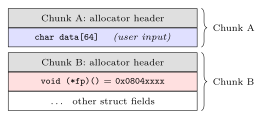
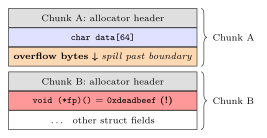
The heap-two binary allocates two heap chunks and prompts for user input. The first chunk is a char buffer; the second is a struct containing a function pointer. A call to strcpy copies user input into the first buffer without bounds checking. Input longer than the allocated size causes overflow, corrupting the function pointer in the second chunk with an attacker-chosen value. Listing 2 shows the essential pattern.
#define DATA_SZ 64

struct item    { char data[DATA_SZ]; };
struct handler { void (*fp)(void);   };

struct item    *A = malloc(sizeof *A);
struct handler *B = malloc(sizeof *B);
B->fp = &safe_function;   /* default */

/* No bounds check: if strlen(input)
   exceeds DATA_SZ, bytes spill from
   A->data into B->fp.               */
strcpy(A->data, user_input);

B->fp(); /* attacker-chosen target */Execution workflow: gdb session.
We run the binary under gdb to observe heap layout and exploitation step-by-step:
Start the binary:
gdb ./heap-twoSet breakpoint before vulnerable
strcpyContinue to breakpoint:
runInspect heap state before overflow:
x/20xat Chunk A’s address (exact address obtained from prior breakpoint)Identify the function pointer location
Step through
strcpy:niRe-examine memory after overflow
Observe the overwritten function pointer
Heap layout and the overflow.
Figure 1 shows the heap before overflow: two malloc calls produce chunks A (user buffer, 64 bytes) and B (struct with function pointer). When strcpy copies attacker input without bounds checking, bytes beyond chunk A’s boundary overwrite chunk B’s function pointer. Figure 2 shows the heap after overflow, with chunk B’s pointer rewritten to the address of a winner() function.
Exploitation: crafting the payload.
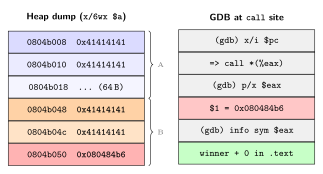
The attacker constructs a payload filling chunk A with padding, then encodes the winner() function address in little-endian format to overwrite the pointer in chunk B. The program crashes at the attacker-chosen address: a successful exploit. Figure 3 confirms this: the left panel shows the heap state after overflow, with the victim buffer (blue), the overflowing bytes that corrupt Chunk B’s header (orange), and the function pointer rewritten to winner()’s address (red); the right panel shows GDB at the call instruction, with $eax pointing to winner().
Connection to CVE-2025-43300.
The structural parallel is exact: both grant a controllable heap write that overwrites an adjacent function pointer, confirmed above by Figure 3. Section IV draws the structural comparison to CVE-2025-43300 in Figure 5, which aligns the two heap layouts side-by-side against Quarkslab’s reconstruction of the ImageIO decoder [17].
Tools and Primary Sources
All materials used in this study are publicly available; a summary is given in Table II. No proprietary data, no non-public code, and no new reverse engineering of Apple or WhatsApp binaries is produced or relied upon. The paper’s analytical contribution is in synthesis and pedagogical framing, not primary discovery.
| Tool / source | Role |
|---|---|
gdb |
Heap and register inspection |
checksec |
Mitigation-state verification |
| Phoenix VM [27] | Environment for heap-two |
| Quarkslab report [17] | CVE-2025-43300 root cause |
| Apple, WhatsApp advisories | Canonical CVE descriptions |
| NVD entries | CWE class, CVSS, affected versions |
| CISA KEV [4] | Exploitation confirmation |
References
- [4] CISA (Cybersecurity and Infrastructure Security Agency), “Known Exploited Vulnerabilities Catalog”, Online catalog, 2025.↩
- [17] Quarkslab, “Reverse Engineering of Apple's iOS 0-click CVE-2025-43300: 2 Bytes That Make Size Matter”, Research blog, 2025.↩
- [27] Exploit Education, “Exploit Education Phoenix VM”, Free educational platform, 2024.↩